
This is the creative piece written as the final stage of the heuristic research I undertook for my MA dissertation. The research examined the invisibility of mothering in the Person-Centred Approach.
Heuristic research involves researching and immersing yourself in a subject and then consciously stepping back to see what spontaneously emerges. I was skeptical but then late one night during a COVID lockdown the first line came to me. I got up and wrote this piece in one steady flow then went back to bed quite amazed and feeling that I had said what I had been feeling for some time. The chair in the photograph is the one my clients sat in on my placement.
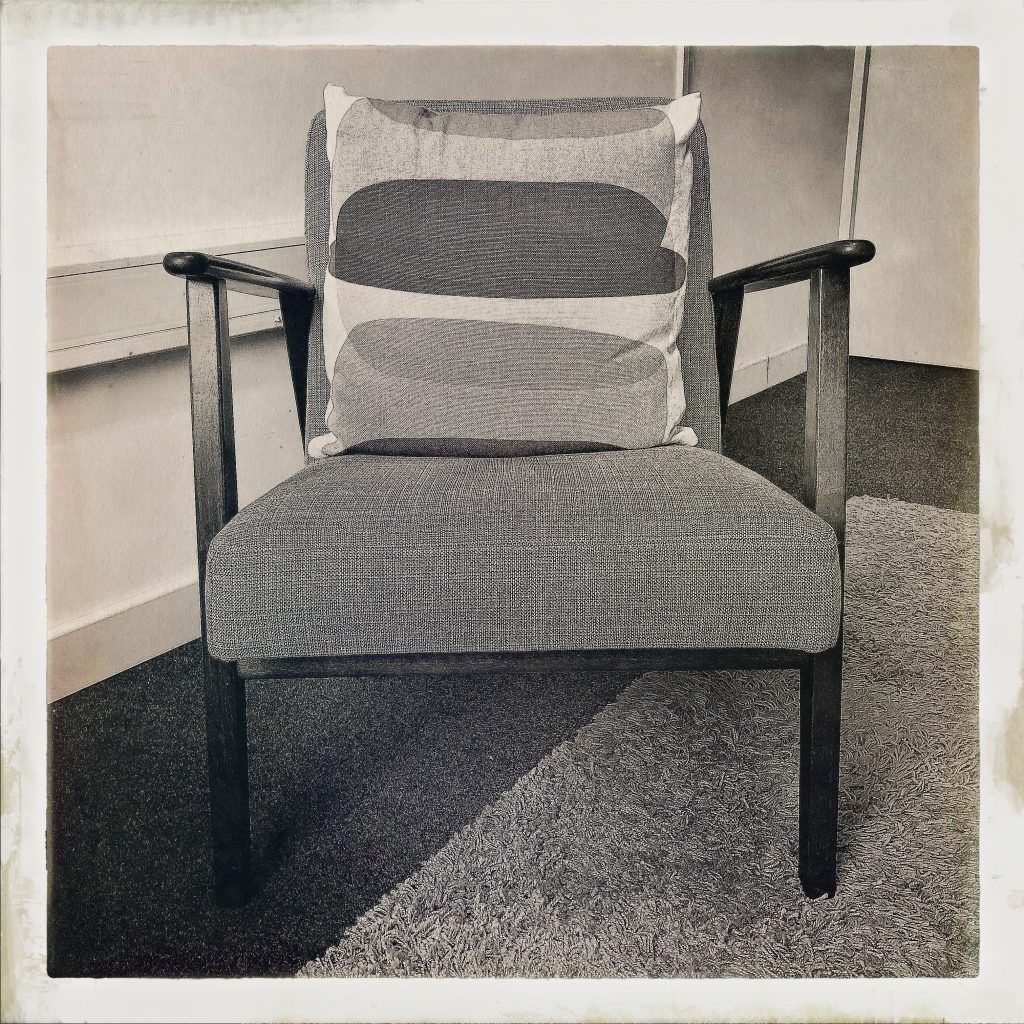
A therapist sits in her therapy room at the end of a busy day seeing clients in a postnatal clinic.
I can feel it as I sit here, a deep hum connecting me with the women I spoke with today. A resonance connecting us together. Apparently, the lowest frequencies have the most energy, they move you and pull at your belly. It feels like a thick cable carrying the energy between us. I don’t know what that energy is, because we’re all permanently knackered. Maybe it’s the energy that keeps us going, when we think we can’t do one more task and that little person needs us. Or maybe it’s the hum of a force field keeping us from something, keeping us in our place. Either way it’s a relentless push, something displacing us from where we might want to be.
To me, that hum is also connection, and it’s easy to miss that and feel alone, so that connection needs to be nurtured. The connection keeps me sane. Motherhood was summed up for me one Christmas eve when my son was sick. He vomited – right into my mouth – and my first thought was ‘Is he okay?’. Who else could do that to me and still make me think that?
And that first client today, such a traumatic birth, and now six months later and no time to process any of it because she’s busy keeping a small person alive. How do you look after yourself when you’re life and death to your own flesh and blood? And everyone says, ‘Your baby’s fine so everything’s okay, isn’t it?’ They don’t want to hear anything else, it’s all about the adorable baby, not losing two litres of blood and struggling to breastfeed because the hormones she needed ended up on the hospital room floor. It doesn’t matter if they have a bottle does it? But maybe it does to that mum. When society doesn’t see it, can’t see it, it needs to be seen here, in this room, it needs to be heard. But if she’s not ‘coping’ then she’s ill, postnatal depression. Not postnatal adjustment, not postnatal grief or trauma, just defective. Like labour – failure to progress, incompetent cervix, lack of maternal effort, untried pelvis, even the medical notes judge.
And the mothers without babies. No one speaks of them. Nameless babies without a weight or ‘They look so much like…’ ‘At least you’re still young enough to try again’. Grief isn’t acknowledged or allowed because how can you miss something you’ve never had? But that grief is strong, saying goodbye before you’ve said hello is the hardest goodbye.
Those relentless first weeks break you and with luck you’ll be able to put yourself back together again into something you’ll recognise. Then I started training and I had to take it all apart again. It was an oasis and a breath of fresh air, somewhere where I wanted to be just me but then I realised that what I had to offer was the part of me that was still connected to that boy at home. At first it was about how that boy struggled without me but then I realised it was still about me, it was about the part of me that was connected with his struggle.
So now I’m sat here with all this inside me. It’s my stuff, it’s not in that chair over there but it’s linked, we’re all linked with that deep, deep hum. But I need to know what’s inside me. I need to look at it and be as familiar with it as I am with his face so that I know what’s mine and what’s in that chair.
Before, I remember being on the outside looking in. I remember being at a wedding when I was young, when people still welcomed babies to weddings and the next generation got to contemplate what it might be like to have a real one and not just a Tiny Tears. We all knew it was hard work like no other but it also seemed simultaneously simple and unknowable from the outside. Simple that they just needed to be clean, fed and loved but I didn’t know – who could know – how much turning from two to three shifts you. It’s a jolt when you no longer know where you end and they begin and who you are any more. Someone asked if she was a ‘good baby’ and they said ‘yes’ because there’s no other answer. But we could have listened, we could have asked. But we didn’t. We didn’t ask about the stuff that’s too big for words – that needs time and acceptance to hear. We had our own thoughts that we hadn’t learned to put aside yet. We didn’t even know those assumptions were there because we were taught them so well.
But you grow. You must or you drown. I learned so much about myself when I found the space to do that. I needed someone to listen to me, not just check on him to see if I was doing it right – because there was lots I probably wasn’t. I needed to know those mistakes were okay too or there’d be no space for me. That’s what I want to offer in that chair over there, a space to grow and a space for that hum to be heard, tuned into and held delicately until it releases its energy to keep us going.
